

Why We Don't Trust Third-Party Lead Companies

How Lead Services Really Work
As a contractor our first real exposure to a third-party company was the testimony of homeowners on social media platforms. We noticed complaints about third parties and the contractors that were hired through them. After further investigation we gained a glimpse into potential risks for homeowners using these service providers.
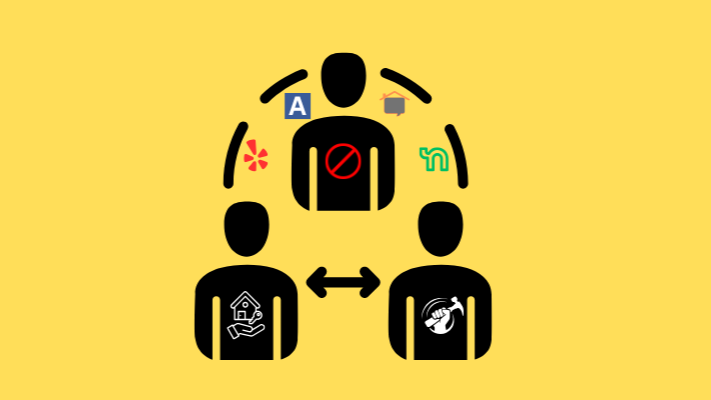
For contractors, third-parties act as a liaison to the homeowners in the form of leads. For homeowners, they act as a connection to contractors when they need a service, and they are subsequently known as service providers. On the most basic level, all of them collect information from the homeowner and sell it to a contractor.
Some of these third-party service providers claim to provide homeowners with "screened service providers", but when we examined their process more closely, the process only involved a check for a business registration and insurance. Just because a contractor may register a business with the state and carry insurance, does not mean they are a “quality” contractor and it does not prove anything about their experience, quality of workmanship, their ability to communicate effectively with homeowners, or the contractor’s ability to manage time.
Contractors that use lead companies are often given a set of inflated numbers about the number of leads they will receive. The problem here is that there may be a good number of leads, but those leads are sent to several contractors at once. The homeowner is bombarded with several calls; the contractor is just a needle in a haystack.
The Pitfalls of Angi and HomeAdvisor
(Both Owned by IAC Inc)
- Ownership & Lead Sharing
-Misleading “Happiness Guarantee”
- Scenarios For Homeowners to Think About
Angi offers its services free to the homeowner, to a point. In order for a homeowner to receive the full benefits of Angi, they must pay for a premium membership. Contractor’s are urged to sign up for Angi Leads, which promises an increase in work.
Angi offers discounts, but it’s the contractor forced to offer them higher visibility. The deeper the discount a contractor offers, the higher the visibility to homeowners. The higher the discount, the higher the business is listed. The homeowner must pay for a premium membership to get the discount. The contractor takes the loss, and the third-party gets the profit in the form of a premium membership fee and the contractor paying for Angi Leads. To make up for the difference, some contractors are forced to increase bids to leads they find on Angi.
HomeAdvisor and Angi are owned by the same parent company. In 2017 they were both acquired and merged by IAC Inc. IAC is an American investment holding company. Investment holding companies seek to acquire, own and manage companies rather than sell or provide products and services. Both HomeAdvisor and Angi still operate under their own perspective websites and names. They exist as separate entities and brands, but all financials and customer information is shared and they are controlled by one governing body that is only in the business to acquire assets. When homeowners sign up for either company looking for a contractor, both companies share the user information and distribute the same leads to multiple contractors on both platforms.
HomeAdvisor and Angi both claim to "connect you with qualified and screened service professionals for home projects", both offer homeowners "The Happiness Guarantee", claiming, "When you book and pay with us, we’ll cover your project up to the full purchase price, plus limited damage protection. If you’re not satisfied with your project or service, we’ll work to make it right." This is how they are marketing themselves to homeowners.
If a homeowner reads the fine print, they would see that this guarantee does not actually apply to every homeowner or every situation. Here is a quick breakdown of that guarantee:
o First, you'll see that you need to book through HomeAdvisor directly.
o Second, you have only 72 hours to report an issue.
o Your HomeAdvisor account needs to be in good standing
o A homeowner must accept the first option of having the original contractor come and fix the issue, and you can only receive replacement or compensation if repairs are proven not to be an option.
The guarantee the homeowners are getting is one with narrow margins, some of which are impossible to meet for actual claims. As a contractor, we see the flaws in these guarantees.
1. Not every homeowner wants to hire the same contractor who was originally hired, especially when the contractor did not do quality work or there were problems with his workmanship. No homeowner wants to put the effort in chasing down a contractor that has already “failed” them.
2. Not every issue shows up within 72-hours. There are several scenarios in which a homeowner may not realize something was wrong with the workmanship until after the 72-hour window has passed.
Limitations of NextDoor
-Small neighborhoods
NextDoor is limited to neighborhoods. We had a client recommend NextDoor to us, hoping to help us get more exposure. We signed up for NextDoor, which requires that you set up a business profile page so people can see you. NextDoor's reach is only to homeowners in specific neighborhoods. For us, it isn't feasible to be in one neighborhood, and according to NextDoor we would need to sign up for another account to get into more than one neighborhood. Our service area covers all of Rockingham and Stafford Counties in New Hampshire, one neighborhood in Derry, NH is not worth what NextDoor charges for leads.
We have found that setting up a business profile, which is free of charge, does increase exposure.
Yelp’s Deceptive Nature
-Content Ownership Concerns
-Misleading Quote Request Concerns
Yelp was by far the most challenging and frustrating for us as a company. We originally signed up to Yelp because when Yelp started in 2004, they were a trusted platform for business reviews. When I began to investigate Yelp, I discovered it also acts as lead company.
Yelp also requires businesses to create a business profile page when they sign up. You have to pay to be able to upload your business logo, but they allow you to upload photos of your projects at no charge, which we originally thought was a good idea.
The first thing we noticed was that Yelp uses an algorithm to determine which photos to display and how they are displayed. They determine what captures your audience and you don’t really have control over how it is displayed after you upload your photos.
When we took a closer look at the user terms agreements for Yelp, we encountered several concerns. One of them regarded the content we were uploading.
"We may use Your Content in a number of different ways, including by publicly displaying it, reformatting it, incorporating it into advertisements and other works, creating derivative works from it, promoting it, distributing it, and allowing others to do the same in connection with their own websites and media platforms (“Other Media”). By uploading the work we have done, we have given Yelp the rights to it. It may not seem like a big deal, but they can manipulate and distribute photos of the work we have done, and they give the rights to "others" to do the same. We take pride in our work and have uploaded examples of our work to create transparency with our clients, but it seems Yelp claims those rights as its own."
Yelp owns the rights to our project photos and can use them however they see fit. They can even allow others to use them at their own discretion. We have essentially signed over the rights to photos we have taken of work we have done.
In the service user agreement, we also found this, which leads to my next point about Yelp.
"By accessing or using the Service, you consent to receive communications from other users and Yelp through the Service, or through any other means such as emails, push notifications, text messages (including SMS and MMS), and phone calls. These communications may promote Yelp or businesses listed on Yelp, and may be initiated by Yelp, businesses listed on Yelp, or other users. You further understand that communications may be sent using an automatic telephone dialing system, and that you may be charged by your phone carrier for certain communications such as SMS messages or phone calls.”
We were inundated with phone calls and emails from Yelp representatives trying to sell us more services.
My greatest concern about Yelp, is that it allows homeowners to "Request a Quote". In truth, as a contractor, I have no control over whether a homeowner can "Request a Quote" from us as contractors because Yelp is allowed to use my business profile and my account information to advertise to homeowners whatever it wants to.
Quite honestly, we have never given a homeowner a quote without meeting with them to further evaluate needs and get more information about the space we will be working in. There are just too many factors involved in what we do, to be able to give an accurate estimate without meeting with the homeowner, and as a contractor I believe that most reputable contractors follow this course of action. In addition to this, we have been made aware of scams that could take advantage of this very scenario.
Despite this, Yelp offers this option, which immediately sets ground for false expectations from a homeowner, and it isn't the contractor’s or the homeowner’s fault.
When testing the “Request a Quote” available through Yelp, I discovered that Yelp too, sends homeowners leads to several contractors, even if a homeowner request a quote from one company.
Solutions and Alternatives
For contractors and homeowners alike, I would work toward understanding the pitfalls of Third-Party Service Providers. These providers have injected themselves into intermediate sources, but their goal is to make a profit, and their ultimate business is selling information. As a business owner, I feel they found a demand in the new world of technology and are working to fulfill that demand and make a profitable business out of it. That in and of itself is commendable. Their methods are what I question and as a contractor I am weary of these methods because they directly affect our business and how I can personally connect with a homeowner.
Ultimately, a homeowner needs to understand that no "contractor" is vetted and there are never any "guarantees". It is aways up to the homeowner and the contractor to do their due diligence and never go into utilizing or paying for services without checking the user and terms agreements that we often just simply scroll through. We tend to read the big fat headlines without seeing the fine print. Little do we know in some cases we are signing our rights away. Do your research and never assume that a third party has your best interest in mind.
Quick Closing Thought
As a contractor we are always working to build trust between contractors and homeowners. We want to be transparent, and we always want to share information that we come across to establish better connections among all of us. Yes, we do carpentry work, and it is our passion, but part of that work is more than just showing up to a homeowner’s house and doing a project for them. An intricate piece of developing relationships is being able to offer something else entirely, insight.
If you are a contractor and would like to work or collaborate with us in some way, let us know. We believe sometimes more is gained in collaboration than is lost in a competition.
If you are a homeowner and need a project done, we urge you to look at our work and to visit us at www.csecarpentry.com . We would love for you to learn more about us.

Comments